
About
Robert Gaskins invented PowerPoint. He led its initial design and development at a startup, where the idea attracted the first venture capital investment ever made by Apple Computer. PowerPoint was released for Macintosh in 1987, and soon afterward, it became the first significant acquisition ever made by Microsoft, who set up a new business unit in Silicon Valley to develop it further. Gaskins headed this new Microsoft unit for another five years, completing versions of the PowerPoint product which contributed to the explosive early growth of Microsoft Windows and to the dominance of Microsoft Office.
Contact
Gaskins Office
2443 Fillmore Street
San Francisco, California 94115
United States of America
robertgaskins@gaskins.org
Telephone: +1 415 680 2434
Web: www.robertgaskins.com
(w3w location) supply.rocket.stem
Gaskins Office
27, Old Gloucester Street
London WC1N 3XX
United Kingdom
robertgaskins@gaskins.org.uk
Telephone: +44 20 7681 1827
Web: www.robertgaskins.co.uk
(w3w location) gain.torn.atoms
2017: 25th Anniversary of PowerPoint 3.0
PowerPoint 3.0 was created at Microsoft's Graphics Business Unit in Silicon Valley over the five years 1987‒1992, where I was the head of the new Microsoft group during that entire period. The Windows version shipped in May 1992 (announced on the same day as Windows 3.1) and the Macintosh version in September 1992. Following on some interim releases, PowerPoint 3.0 marked the completion of the full original product vision of PowerPoint 1.0, shipped five years earlier; and it turned out to be the basis for continued evolution over another twenty-five years, so far. PowerPoint 3.0 was localized into all major languages very rapidly, and soon became the international standard for presentations; it quickly achieved a dominant market share worldwide, which has been maintained ever since.
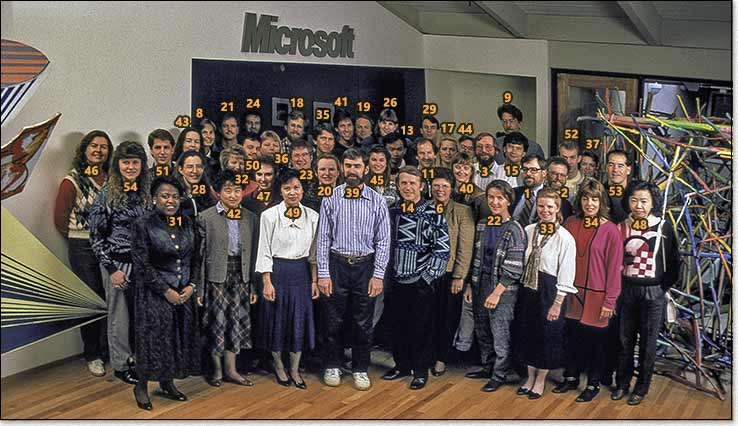
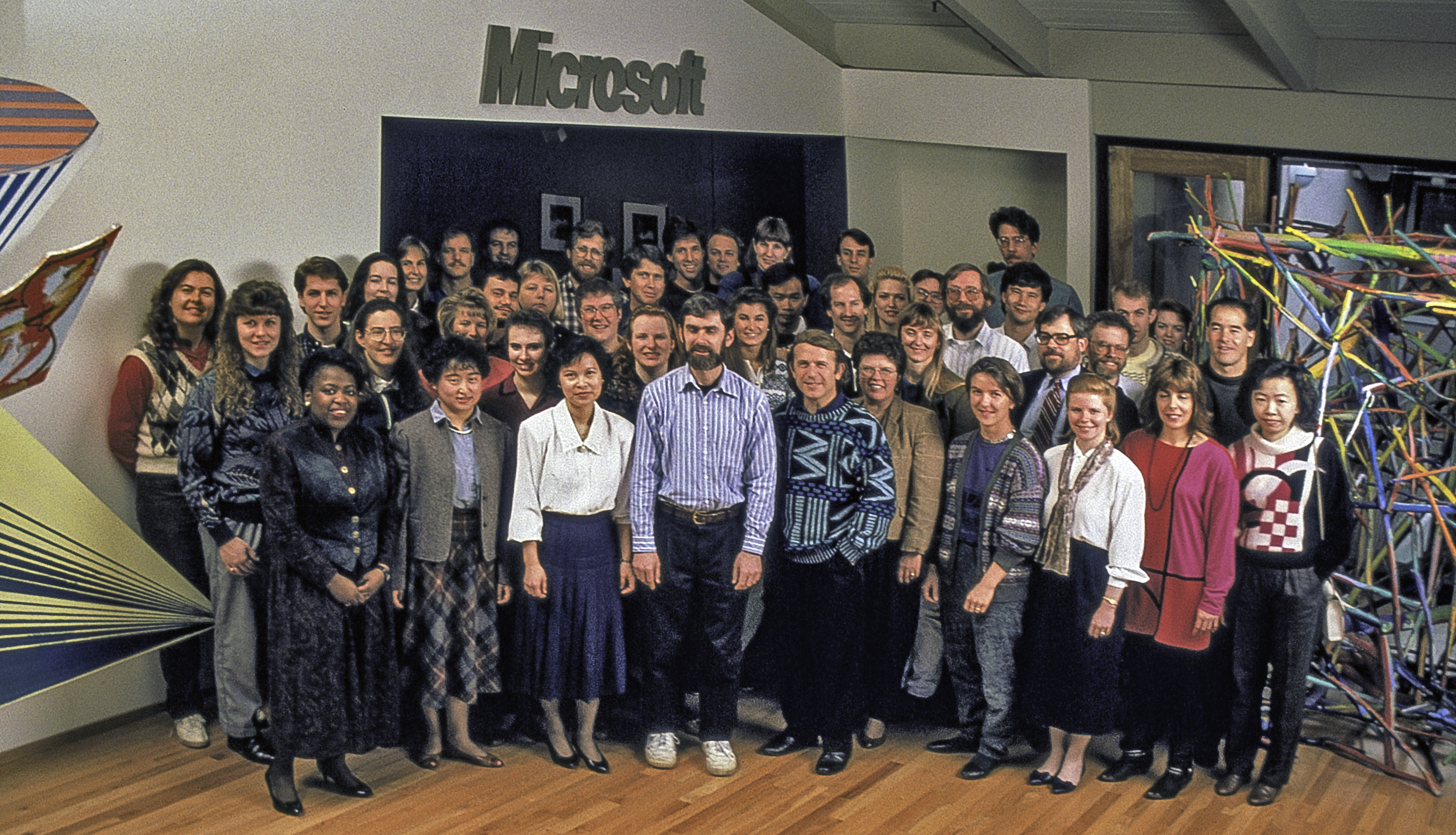
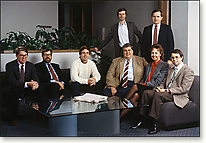
The core team that created PowerPoint 3.0 in 1992
(mouse over or touch photo to enlarge faces)
This picture was taken in the lobby of the Microsoft Graphics Business Unit building in Silicon Valley, at 2460 Sand Hill Road, Menlo Park, California, in the oak-covered hills overlooking the Stanford campus. The artwork glimpsed to the left of the group is Giufà, la luna, i ladri e le guardie, 4X (1984), by Frank Stella, mixed media on canvas, etched magnesium, aluminum, and fiberglass, now in the collection of the San Francisco Museum of Modern Art. To the right is Untitled (1981), by Charles Arnoldi, acrylic paint on tree branches, now in the Anderson Collection at Stanford University. These were just two out of more than a hundred important contemporary artworks (valued even then at over $100 million) which were on display in the Graphic Business Unit’s offices, and lent an appropriate dynamism to our public areas and conference rooms. Every person had a soundproof private office with a door, window views of the outdoors, and all technical people had a minimum of three computers—Windows, Mac, and Unix [Xenix].
Update: A reader familiar with the team writes to point out that, out of the list of 60 names above, 41 Microsoft people were in technical engineering positions (development, program management, or quality assurance): 22 men (54%) and 19 women (46%). The reader notes: “That was a very unusual balance in 1992, and would still be unusual today.”
Link for a large (8 MB) version of the group photo above (without numbers):
Photo: the core team that created PowerPoint 3.0 in 1992.
See also: one hundred more pictures from the same time, including more people, more offices, and more art,
in the form of a PowerPoint slideshow (30 MB):
PowerPoint slideshow: one hundred pictures of the core team that created PowerPoint 3.0 in 1992
Directions to the Microsoft GBU, 2460 Sand Hill Road, Menlo Park (1 page), 1991
The long-term success of PowerPoint is based on the foundation of PowerPoint 3.0, but of course it has depended on many people beyond the core team. When PowerPoint 3.0 was under development at the Graphics Business Unit, it also relied on contract publication designers, artists, and writers from Publishing Power; on contract designers, artists, and testers from Genigraphics; on contract engineering from Bear River Associates and testing laboratories; and on hundreds of people in functional groups at Microsoft headquarters and at the international subsidiaries.
Over the following twenty-five years, it has depended on the continuing superior efforts of thousands of other Microsoft people, who have improved PowerPoint and renewed it through the appearance of new platforms and repeated technological revolutions. If the PowerPoint product had been ignored and allowed to become obsolete, it would now be as long-forgotten as most of the other products introduced twenty-five years ago into that very different world.
2012: 25th Anniversary of PowerPoint 1.0
PowerPoint 1.0 was created at the startup Forethought, Inc., in Silicon Valley over the three years 1984‒1987, where I invented the idea and managed its design and development. During its development, PowerPoint attracted the first venture capital investment ever made by Apple, and then soon after shipping it became the first significant acquisition ever made by Microsoft, who set up a new Graphics Business Unit in Silicon Valley to develop it further.
Although initially planned for Windows, the first version was shipped for Macintosh. Three people made the earliest and most critical contributions. First, it was my idea and I started working on it in July of 1984. Second, Dennis Austin very soon joined me, in October 1984, and we then worked closely together for about a year and a half—a lifetime in startup years. Third, in May of 1986 we were joined by Tom Rudkin, and the three of us worked together for about another year—another good long time.
At the end of that period, nearly three years of intensive work, we shipped PowerPoint 1.0 for Mac, with the program files on the diskettes dated 20 April 1987. Three months later, we joined Microsoft to manage its new business unit in Silicon Valley and to continue our work on PowerPoint, aiming to complete the full product vision which couldn’t be included in the first release (which we did, five years later, in PowerPoint 3.0).
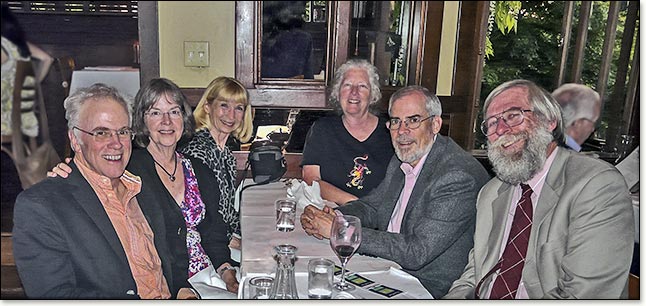
at Chez Panisse, Berkeley, 8 May 2012
From left: Dennis Austin, Jan Austin, Leanna Gaskins,
Jann Rudkin, Bob Gaskins, Tom Rudkin
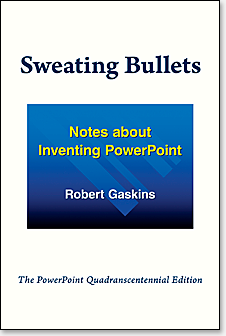
Sweating Bullets:
Notes about Inventing PowerPoint
“PowerPoint was the first presentation software designed for Macintosh and Windows, received the first venture capital investment ever made by Apple, then became the first significant acquisition ever made by Microsoft, and is now, twenty-five years later, installed on over one billion computers worldwide.”
“Robert Gaskins (who invented the idea, managed its design and development, and then headed the new Microsoft group) has written this book to commemorate the twenty-fifth anniversary of PowerPoint, recounting stories of the perils narrowly evaded as a startup, dissecting the complexities of being the first distant development group in Microsoft, and explaining decisions and insights that enabled PowerPoint to become a lasting success.”
Published by Vinland Books 2012,
Hardcover 6" × 9", 512 pp., $35.00
(ISBN: 978-0-9851424-0-7)
Full PDF searchable, 512 pp., Free
(ISBN: 978-0-9851424-1-4)
Paperback 6" × 9", 512 pp., $17.99
(ISBN: 978-0-9851424-2-1)
Ebook for Kindle (all platforms), $2.99
(ISBN: 978-0-9851424-3-8)
Ebook EPUB (Google, Apple), $2.99
(ISBN: 978-0-9851424-4-5)
Where to Buy
Hardcover and paperback formats are available worldwide at Amazon.com, Amazon UK, Amazon France, Amazon Germany, Amazon Spain, Amazon Italy, Amazon Canada, Amazon Japan, Amazon China, Amazon India, or buy from Barnes and Noble, or buy from booksellers around the world via Abebooks, or find the book from a local independent bookstore via Indiebound, or order online with free worldwide shipping to over 100 countries .
Ebook formats are available worldwide through Amazon Kindle stores (US, UK, France, Germany, Spain, Italy, Canada, Japan), Google Play stores (US, UK, Australia, Brazil, Canada, France, Germany, Italy, Japan, Korea, Russia, Spain), and Apple iTunes stores (US, UK, France, Germany, Canada, Australia).
Full PDF format (fully searchable and with links to references) is available worldwide for free download here, www.robertgaskins.com/powerpoint-history/sweating-bullets/gaskins-sweating-bullets-webpdf-isbn-9780985142414.pdf.



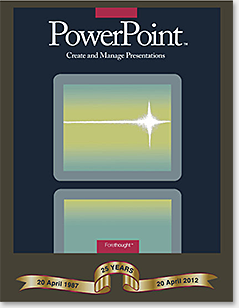
PowerPoint 1.0 for Macintosh 1987
T-Shirt 25 Year Re-Issue
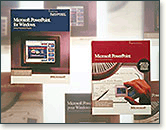
The original pre-Microsoft packaging for PowerPoint 1.0 for Macintosh, as shipped by Forethought on 20 April 1987. Now re-issued as a T-shirt for the 25th anniversary of PowerPoint.
T-shirts by American Apparel; choose any of 21 T-shirt colors, light or dark, in sizes and styles for men and women. High quality printing by RedBubble.
Order from RedBubble for $20.98
plus shipping, available worldwide.


PowerPoint 1.0 for Macintosh 1987
Tote Bag
The original pre-Microsoft packaging for PowerPoint 1.0 for Macintosh, as shipped by Forethought on 20 April 1987. Now re-issued as a tote bag for the 25th anniversary of PowerPoint.
Choice of sizes, 13 inches (330mm) square, or 16 inches (405mm) square. Same image available as throw pillows, 16 inches (405mm) square, 18 inches (460mm) square, or 20 inches (510mm) square. High quality printing by RedBubble.
Order from RedBubble for $18.97
plus shipping, available worldwide.
Want a signed copy of the book? You can get a free personalized bookplate, hand-signed by the author, to be pasted into your book. Just send an email note and request to robertgaskins@gaskins.org, and include (1) the name and address to which you want the bookplate sent, and (2) if you’d like any (necessarily brief) inscription.
2007: 20th Anniversary of PowerPoint 1.0

PowerPoint Turns 20,
As Its Creators Ponder
A Dark Side to Success
by Lee Gomes, “Portals” column,
The Wall Street Journal, US edition, page B1, 20 June 2007
Lee Gomes talks with Bob Gaskins and Dennis Austin about how they created PowerPoint, and how they respond twenty years later to criticisms of the way it is now being used.
“ … the culture of PowerPoint is something that bemuses, concerns and occasionally
appalls PowerPoint’s two creators as much as it does everyone else.”
—Lee Gomes
Also in the WSJ Chinese: (simp) PowerPoint今年20岁 (trad) PowerPoint今年20歲
“ 罗伯特•加斯金斯(Robert Gaskins)是一位具有远见卓识的企业家。 早在80年代中期,他就意识到商业幻灯片这一巨大但尚未被人发掘的市场同正在出现的图形化电脑时代形成了完美的结合。”
“Robert Gaskins was the visionary entrepreneur who in the mid-1980s realized that the huge but largely
invisible market for preparing business slides was a perfect match for the coming generation of graphics- oriented computers.”
—Lee Gomes
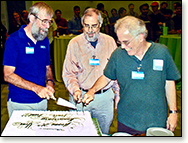
Microsoft’s celebration for all the people currently working on the PowerPoint team was held at the Silicon Valley Campus
on 17 August 2007. The photo shows special guests Tom Rudkin, Bob Gaskins, and Dennis Austin
(L. to R., GBU Wizards
#3, #1, and #2)
collaborating to solve how to divide a cake into 200 equal portions; the cake’s inscription reads
“Happy 20th Year Anniversary PowerPoint!”
Headline speaker was Jeff Raikes, President of the entire Microsoft Business Division, who had the idea to acquire PowerPoint and got the deal done back in 1987.
(Photos by Judea Eden, herself GBU Wizard #17 in 1988.)
Invited “Viewpoint” column for Communications of the ACM
“Robert Gaskins reflects on the 20th anniversary of his invention—PowerPoint—and how simplicity, not limitations, ruled its design and inspires its legacy.”
—Diane Crawford, Editor CACM
“PowerPoint at 20: Back to Basics”
by Robert Gaskins,
CACM, vol. 50 no. 12 (December 2007).
doi: 10.1145/1323688.1323710
free: PDF or HTML gated: ACM
“Despite the lush graphics effects so easily produced by modern presentation programs, most presenters should return to formats nearly as spare as the old overhead transparencies … more matter with less art.”
—Robert Gaskins
Press
-
Next Slide Please: A Brief History of the Corporate Presentation
by Claire L. Evans,
MIT Technology Review, 11 August 2023“At this scale, PowerPoint’s impact on how the world communicates has been immeasurable.”
-
Everything I Know about Life I Learned from PowerPoint
by Russell Davies,
(London: Profile Books, 2021, 262 pp.
ISBN: 978-1-78816-737-6)“One of the things that quickly becomes apparent is that PowerPoint was actually invented. Creative, structural, novel and non-obvious decisions were made about it. Decisions that were responsible for its success, decisions that summoned a whole software category to life and defined it to this day. … it would be easy to assume that PowerPoint was inevitable—as natural a part of ‘office’computing as word processing and spreadsheets. Not true.”
-
If You and Your Friends Are Bored, PowerPoint Parties May Be the Answer
by Julie Beck,
The Atlantic, 27 March 2020“ … she talks with a group of eighth graders … who are stuck at home because of the coronavirus pandemic. To entertain themselves, they hosted a PowerPoint party on Saturday. Each of them prepared a slide presentation on a topic of their choice (ranging from astronomy to unsolved murders to Disney princesses) and shared it with the others over the videochat software Zoom. They … explain the appeal of a PowerPoint party over other kinds of virtual hangouts.”
-
Using PowerPoint, Artists Ask How Performative Presentations Shape Our Thinking
by Shannon Mattern,
ARTnews, 5 February 2020“The software that emerged as ‘Presenter’ more than thirty years ago, then became PowerPoint and its brethren, has transformed the way we teach and hold meetings and manage relationships and worship. … Recognizing the ubiquity and epistemic imperialism of the slide deck, many artists—including David Byrne, Tan Lin, Daniel Eatock, Timothy Evans, Michael Riedel, Linda Dong, Simon Denny, and Tony Cokes—have taken up the medium, adapting its modes of address to comment on contemporary managerialism, information labor, and media culture.”
-
PowerPoint (Discussion of Knoblauch, PowerPoint, Communication, and the Knowledge Society)
by Christian Heath,
s.v. the letter “P” in Schnettler, B. et al. (eds), Kleines Al(e)phabet des Kommunikativen Konstruktivismus, pp. 347‒350,
Springer VS, Wiesbaden,
published 19 February 2019
doi: 10.1007/978-3-658-24958-8_17“On the crumbling wall of a former C18th foundry in a small town in England, there is a short notice. It reads ‘in this furnace, Abraham Derby frst smelted iron ore with coke and thus began the modern age.’ It is perhaps misleading to compare Abraham Derby’s extraordinary innovation with ‘the world’s frst laptop presentation’ in Paris in 1992, and yet Robert Gaskins and his colleagues have to be credited with a development that has radically transformed the way in which knowledge is communicated and instantiated. … a seemingly innocuous innovation has had a profound impact, not only on science and education, but business, the law, medicine, and even religion.”
—Christian Heath
(Professor of Sociology,
King’s College London) -
Has PowerPoint Inexperience Now Become a Firing Offense?
featuring Kate McKinnon and Aidy Bryant,
Saturday Night Live, 09 Mar 2019
(series 44, episode 15).“Two women struggle to make a PowerPoint Presentation.”
-
Review of Robert Gaskins’s book, Sweating Bullets: Notes about Inventing PowerPoint
by Steven Sinofsky,
a16z.com, 25 Dec 2018“A fantastic founders story told by founder and creator of PowerPoint, Bob Gaskins. This book details all aspects of the history of the product from before the genesis (founder origin) … . It details the journey after the acquisition of Forethought through their move to Sand Hill Road R&D offices, the full rewrite in C++, and becoming a cornerstone of Office for Windows and Mac.”
“PowerPoint achieved a degree of ‘world changing’ that few products do; from the boardroom to the classroom to the courtroom to the pew, PowerPoint has defined how people deliver information, good, bad or otherwise.”
“In a series of over 200 1‒3 page almost-‘blog’ posts, Bob details many specific scenarios such as deciding which platforms to target, which tools to use, the first screen presentation, transition to color Mac, and more. This is enormously fun to read.”
—Steven Sinofsky
(former Senior VP of Office and former President of Windows at Microsoft) -
PowerPoint Is the Most Efficient Way for Kids to Manage Their Parents
by Katherine Rosman,
New York Times, 20 Dec 2018“Makennah Gatica, who is in eighth grade in Lubbock, Tex., knows exactly what she wants for Christmas: record albums, Puma sneakers, posters and slippers, all relating to her love of BTS, the South Korean boy band. To convince her mother to buy some of these items, Makennah, who is 13, created an 85-slide PowerPoint presentation. … Rather than just emailing the document, she delivered its contents in person, standing before her mother to make the full audiovisual pitch. ‘I like to add music and do my own intros and stuff,’ Makennah said.”
-
Why Is PowerPoint Having a Comedy Moment?
by Justin Caffier,
Vulture.com, 01 Nov 2018“Wearing a black shirt and headset mic, the speaker paces the stage, expounding upon each new bullet point that appears on the screen behind him, while thousands of audience members sit in rapt attention before breaking into roars of laughter … it’s comedian Demi Adejuyigbe … and he’s delivering the joke with boring old office software that’s recently found a second life in the comedy world: PowerPoint.”
-
It’s Not Just You — PowerPoints Are Having A Moment
by Kathryn Lindsay,
Refinery29.com, 09 May 2018“PowerPoints are popping up on Tinder profiles and being sent to first dates … they’ve officially transitioned from the classroom and boardroom to the Garden of Earthly Delights that is modern pop culture … .”
-
Acquired Podcast: PowerPoint
by Ben Gilbert and David Rosenthal,
Acquired.fm, 04 May 2018“ … this is the same story as Uber, right? This is the same story as Instagram. It’s just in an office environment and with PCs. It’s incredible that there was instant product-market fit, even as the product changed so dramatically. The world wanted exactly what PowerPoint was—the first, second, and third times. And … PowerPoint right now owns 95 percent of that market. That is, that is unreal.”
[With the PowerPoint acquisition, Microsoft Office has] “ … probably done over three hundred billion dollars of revenue since the beginning of Office, and just Office, not including Windows ... I don’t think it would be where it is today without having PowerPoint.”
—Ben Gilbert(length: 01:13:58, includes transcript)
-
Our love-hate relationship with PowerPoint
by Sarah Keating,
BBC Capital, 25 January 2018“PowerPoint is one of the most successful, enduring and influential pieces of software ever invented. … Bob Gaskins was the man behind it.”
-
How PowerPoint was created
by David Pescovitz,
BoingBoing, 01 November 2017“(Robert Gaskins) envisioned the user creating slides of text and graphics in a graphical, WYSIWYG environment … . The presentation would spring directly from the mind of the business user, without having to first transit through the corporate art department.”
Discussion of: The Improbable Origins of PowerPoint
“PowerPoint is so ingrained in modern life that the notion of it having a history at all may seem odd.”
—David C. Brock (writing in IEEE Spectrum) -
PowerPoint at age 30 has many fans among Millennials
by Robert Gaskins,
Indezine, 05 May 2017
“Perhaps it really should not come as a surprise that the generation schooled to use PowerPoint, when faced with new requirements, would find innovative ways to use the tool they already knew well.”
—Robert Gaskins -
A 30-Year Success Story
by Rebecca Burn-Callander,
Gulf News, 27 April 2017“… new research showing that [PowerPoint] remains as popular with young tech-savvy users as it is with the Baby Boomers. An online poll by YouGov showed that 81% of UK Snapchat users agreed that PowerPoint was a great tool for making presentations.”
-
30 Years Old and Still Going Strong:
A Short History of PowerPoint
by Lyndon Nicholson,
Buffalo 7, published at Eventbrite Blog, 20 April 2017“Today’s PowerPoint is an incredibly powerful piece of software, which has been three decades in the making.”
-
On the Turing Completeness of Microsoft PowerPoint
by Tom Wildenhain,
Presented at Carnegie Mellon 11th Annual SIGBOVIK (2017), 31 March 2017.“More generally, for a given alphabet size a, a PPTXTM [PowerPoint Turing Machine] with n states and m tape cells uses O (n2 + m2) animations and O (nm) AutoShapes.”
—Tom WildenhainPresentation: Video, view from YouTube (5 mins 33 secs)
Paper: Preprint (PDF, typeset in PowerPoint), download from CMU
PowerPoint File: PPTX, download from the author’s website
-
China: “POWERPOINT,” In Spite Of Its Extensive Use And High Reputation, Is Not A Generic
Name And May Be Registered As A Trademark
by Li Yunquan, Wan Hui Da (Peksung IP Group),
Mondaq, published 23 May 2017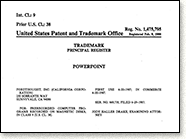
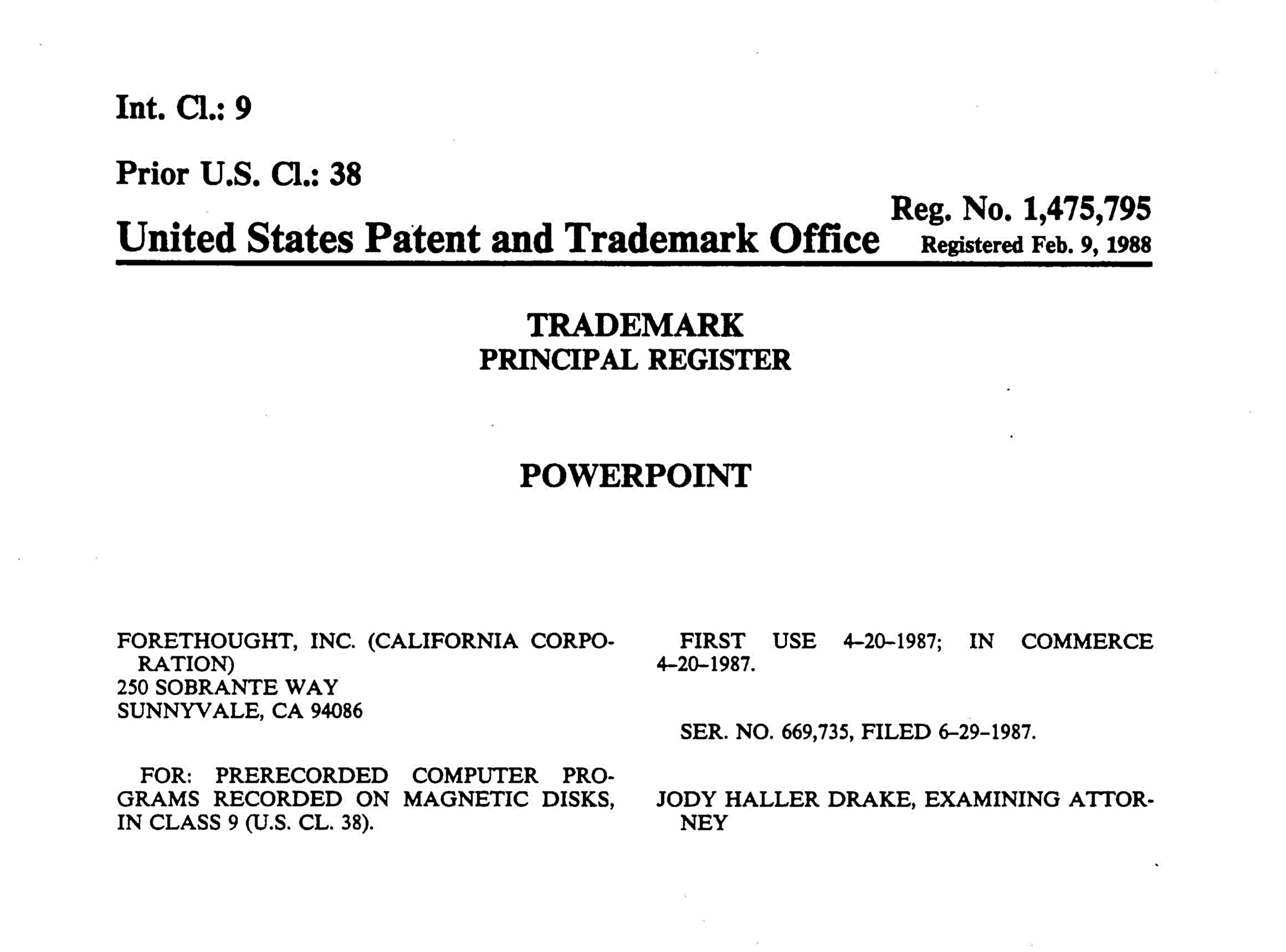
The original US trademark registration for PowerPoint, 1987, pre-Microsoft (click to enlarge).
“ ‘POWERPOINT,’ as a coined word in English, is original. Given that the documented evidence was insufficient to prove that ‘POWERPOINT’ had become a generic name, the trademark ‘POWERPOINT’ could function as a source identifier and was registrable as a trademark.”
—Beijing High People’s Court, 26 December 2016For why and how the word was coined, see also the history of the name in Conversation with Robert Gaskins.
-
The Man Who Invented PowerPoint
Q & A with Robert Gaskins
by Clay Chandler,
Bento, Issue #7, October 2016, Hult International Business School“PowerPoint succeeded because it spread rapidly by viral transmission … every time early adopters used our product effectively, they demonstrated its value to other potential customers.”
—Robert Gaskins -
Stories about PowerPoint History
interviews with Robert Gaskins
by Zamzar BlogPart 1: Deal of the century? How Microsoft beat Apple to buy PowerPoint for $14 million
Zamzar Blog, 10 June 2016
“ … we had been fortunate to launch our PowerPoint product just at the same moment that Microsoft had become convinced that they needed essentially the same product.”
—Robert GaskinsPart 2: Life before the web — Running a Startup in the 1980’s
Zamzar Blog, 13 July 2016
“You had to plan ahead a great distance and ‘call the shot’ accurately, since a considerable investment was required before much in the way of feedback, let alone sales, could be available.”
—Robert GaskinsPart 3: The dream boss? What it was like to work for Bill Gates
Zamzar Blog, 21 Sept 2016
Bill Gates on decentralized knowledge within Microsoft: “We don’t lack the power to enforce our decisions; we lack the information about what we should require.” -
Better Dating Through PowerPoint
by Jessica Guzik,
“The Mission,” Medium, 11 July 2016“To my surprise, applying PowerPoint best practices to my date proposal made me a better dater.”
—Jessica Guzik(Hat tip: Tyler Cowen, Marginal Revolution )
-
29 Bullets
by Russell Davies,
Originally published in Wired UK, 25 May 2016“Steve Jobs once said that the personal computer was like a ‘bicycle for the mind.’ PowerPoint was the first product to make that a reality for millions of us.”
—Russell Davies(The original publication was 29 Reasons to Love PowerPoint . Davies presents it as a web essay styled to resemble the typography of Edward Tufte’s elegant books—a vast improvement over Wired’s edited version.)
-
Inspiring Berkeley alums remind us that graduating doesn’t suck
by Jordan Henigman,
The Daily Clog, A Cal blog by The Daily Californian, 10 April 2013“Berkeley alums from across the board are notorious for doing amazing things with their degrees.” Five examples of “Berkeley brilliance”: Doug Engelbart, Paul Debevec, Marguerite Higgins Hall, Robert Gaskins, and Madelyn Dunham (Barack Obama’s grandmother).
-
PowerPoint at 25: Conversation with Robert Gaskins
by Geetesh Bajaj,
Indezine, 13 August 2012Discusses in part how PowerPoint got its name. In a comment, someone suggests he may be the person who had earlier trademarked “Presenter” for software, thus forcing the extra thought to come up with the distinctive name “PowerPoint.”
-
Viewpoint: How PowerPoint changed Microsoft and my life
by Robert Gaskins,
BBC News, 31 July 2012“Microsoft's earliest acquisition, PowerPoint … may have been more valuable to Microsoft than any of the more than 100 acquisitions it has made since.”
-
Karaoke with a point to make
by Kate Lunau,
Macleans Magazine, 01 July 2010“PowerPoint Karaoke … half improv comedy, half parody of corporate culture, and a way to reclaim one of the most loved—and reviled—computer programs of all time.”
—Kate Lunau -
Mind Over Mass Media
by Steven Pinker,
New York Times, 11 June 2010“These days scientists are never far from their e-mail, rarely touch paper and cannot lecture without PowerPoint. If electronic media were hazardous to intelligence, the quality of science would be plummeting.”
—Steven Pinker, Harvard -
The Underground Art Of PowerPoint
by Andy Greenberg,
Forbes, 11 May 2010“Sometimes I look at the links of what people are creating, and I think, my goodness this is interesting. It’s turned into something far beyond traditional presentations, something that when we were creating it, we never could have imagined.”
—Robert GaskinsSee also: PowerPoint Heaven
“PowerPoint is not simply a presentation tool, but is also capable on leveraging into other areas such as creating games, artworks and animations.”
—Shawn Toh (MVP PowerPoint) -
We Have Met the Enemy and He Is PowerPoint:
Enemy Lurks in Briefings on Afghan War
by Elisabeth Bumiller,
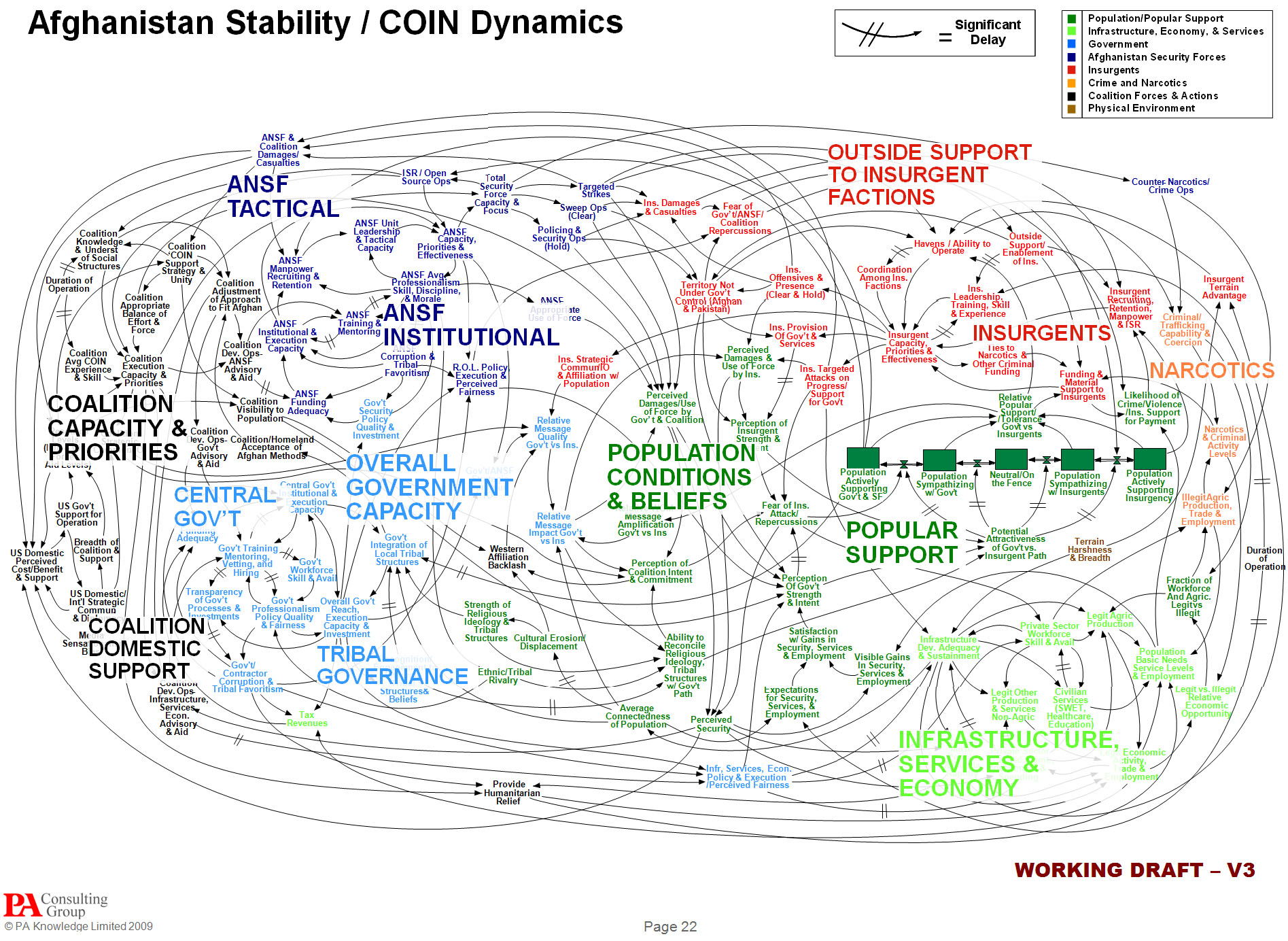
New York Times, 27 April 2010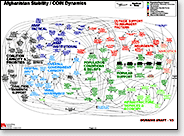 (Click to enlarge slide)
“When we understand that slide, we’ll have won the war.”
—Gen. Stanley A. McChrystalSee also: Letters to the Editor: A Tool Only as Good as the User with responses from readers, New York Times, 30 April 2010:
“Don’t blame the messenger: The problem is not in the tool itself, but in the way that people use it—which is partly a result of how institutions promote misuse.” —Peter Norvig and Stephen M. Kosslynand: Does the Military Overuse PowerPoint? , “The Tank,” Military.com, 28 April 2010:
“With Powerpoint, the military has been moving toward an oral tradition and away from the written word, with all the demands for precision, nuance and serious exposition that writing requires. And it's not just a problem for the military.” —Michael Gordon -
Microsoft Turns 35: Smartest Acquisition Was PowerPoint
by Preston Gralla,
Computerworld, 24 March 2010“Smartest acquisition … PowerPoint [because it] later became one of the core programs of Microsoft Office, which for many years has been the dominant office productivity suite.”
—Preston Gralla -
More Power to Make the Point:
PowerPoint Inventor Robert Gaskins
 让Point更Power:
PowerPoint 的发明人 Robert Gaskins
by 冯磊 (Lori Feng),
信息方略 (CIO INSIGHT), 8 August 2009, pp. 20-24“ 看来,IT这个当今世界最活跃的因子,一旦与其他科学元素联系起来,总会迸发出令人惊艳的创造力。”
—冯磊 (Lori Feng) -
Speaking Truth to PowerPoint:
Should We Blame PowerPoint or the People Using It?
by David Feith,
The Wall Street Journal, 31 July 2009“I do quarrel with logic that says ‘Stupid people are associated with X, therefore X is stupid.’ Stupid people are associated with everything.”
—Larry Wall -
Encyclopædia Britannica
“… presentation software developed by Robert Gaskins and Dennis Austin for the American computer software company Forethought, Inc.”
—Encyclopædia Britannica Online, retrieved 23 Dec. 2008, s.v. “Microsoft PowerPoint”. -
Creating PowerPoint:
The Man Who Changed the Way the World Presents
interview with Linda Cleary,
Mindjet Connections, Aug 2008“It seems to me most people choose the wrong time periods for thinking about work/life balance. … A startup is a chance to balance out your work and life over many decades.”
—Robert Gaskins -
“Big Boost from Berkeley”:
Inventing Critical Breakthroughs
Behind the Personal Computer
by Dick Cortén,
The Graduate (published by the Graduate Division, UC Berkeley), Vol. 20 No. 1, 2008 Revised Version for Web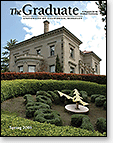
“How [Berkeley] grad students and alums led the design of personal computers,” thirteen of the key contributions including “the world’s most pervasive software program for presentations, PowerPoint.”
—Dick Cortén -
University of Chicago, Graduate School of Business
beginning with its Fall 2008 term requires students to submit PowerPoint presentations as part of their applications for admission.
Background: School Adds PowerPoint to Application“In four slides or less, please provide readers with content that captures who you are. … You are limited to text and static images to convey your points.”
—Chicago GSB Admissions
by Justin Pope,
Associated Press,, 30 July 2007“By adding PowerPoint to its application, Chicago thinks it might attract more students who have the kind of cleverness that can really pay off in business, and fewer of the technocrat types who sometimes give the program a bad name.”
-
PowerPoint Advice for Startups
from Marc Andreeson’s blog,
blog.pmarca.com , 25 June 2007
And Sequoia Capital, a top-tier VC, backs him up by asking founders for no more than that:“Don't bother with a long detailed written business plan. Most VCs will either fund a startup based on a fleshed out PowerPoint presentation of about 20 slides, or they won't fund it at all.”
—Marc Andreeson“We like business plans that present a lot of information in as few words as possible. The following format, within 15-20 slides, is all that's needed … .”
—Sequoia Capital -
Don’t Hate PowerPoint; Hate the PowerPointers
by Stephen J. Dubner,
Freakonomics Blog (New York Times) , 20 June 2007“by far the best part of [Gomes’s] column is the reflections of Robert Gaskins and Dennis Austin, the creators of PowerPoint”
—Stephen J. Dubner -
The Wall Street Journal.
PowerPoint Turns 20,
As Its Creators Ponder
A Dark Side to Success
Lee Gomes, in his “Portals” column for The Wall Street Journal, talks with Bob Gaskins and Dennis Austin about how they created PowerPoint, and how they respond now to criticisms of the way it is being used
(The Wall Street Journal, US edition, page B1, 20 June 2007)
“ … the culture of PowerPoint is something that bemuses, concerns and occasionally appalls PowerPoint’s two creators as much as it does everyone else.”
—Lee Gomes
Also in the WSJ Chinese:
(simp) PowerPoint今年20岁
(trad) PowerPoint今年20歲“ 罗伯特•加斯金斯(Robert Gaskins)是一位具有远见卓识的企业家。 早在80年代中期,他就意识到商业幻灯片这一巨大但尚未被人发掘的市场同正在出现的图形化电脑时代形成了完美的结合。”
“Robert Gaskins was the visionary entrepreneur who in the mid-1980s realized that the huge but largely invisible market for preparing business slides was a perfect match for the coming generation of graphics-oriented computers.”
—Lee Gomes -
Microsoft’s 20-Year PPT Party
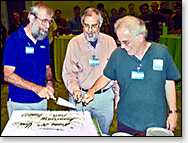
Microsoft’s celebration for all the people currently working on the PowerPoint team was held at the Silicon Valley Campus on 17 August 2007. The photo shows special guests Tom Rudkin, Bob Gaskins, and Dennis Austin (L. to R., GBU Wizards #3, #1, and #2) collaborating to solve how to divide a cake into 200 equal portions; the cake’s inscription reads “Happy 20th Year Anniversary PowerPoint!”
Headline speaker was Jeff Raikes, President of the entire Microsoft Business Division, who had the idea to acquire PowerPoint and got the deal done back in 1987.
(Photos by Judea Eden, herself GBU Wizard #17 in 1988.)
-
Widespread Use of Extraneous Decoration Considered Harmful
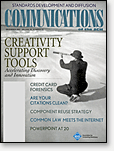
Invited “Viewpoint” column for Communications of the ACM,
PowerPoint at 20: Back to Basics
by Robert Gaskins,
CACM, vol. 50 no. 12 (December 2007).
doi: 10.1145/1323688.1323710
free: PDF or HTML gated: ACM“Robert Gaskins reflects on the 20th anniversary of his invention—PowerPoint—and how simplicity, not limitations, ruled its design and inspires its legacy.”
—Diane Crawford, Editor CACM“Despite the lush graphics effects so easily produced by modern presentation programs, most presenters should return to formats nearly as spare as the old overhead transparencies … more matter with less art.”
—Robert Gaskins -
The “Power Mad”
episode of the BBC series In Business, presented by Peter Day, produced by Neil Koenig,
programme first broadcast on BBC Radio 4, 7 February 2002, and repeated on BBC World Service, 8 June 2002.
Audio of the broadcast (MP3, 6.5 MB)
Transcript of the broadcast
“Let’s ask Bob Gaskins, a man with many intensely held interests …”
—Peter Day -
Die Revolutionäre des Büros
by Steffan Heuer,
Brand Eins, Issue 3, 2002“Ihre Produkte kennt mittlerweile beinahe jeder–doch wer sind die Köpfe hinter Word, Excel und PowerPoint?”
(“The revolutionaries of the office: just about everyone in the world knows their products—but who are the brains behind Word, Excel and PowerPoint?”)
—English translation, Susan Grabau (GBU Wizard #79 in 1993)
(Partial text at Brand Eins archive) -
What’s Your Point, Lieutenant? Please, Just Cut to the Pie Charts
by Greg Jaffe,
Wall Street Journal, 26 April 2000“We should give it to the Iraqis. We’d never have to worry about them again.”
—Peter Feaver, Duke University -
The Linus Interview
(Linus Torvalds on PowerPoint)
by Adam Goodman, Matt Welsh, and Lee Gomes,
Linux Magazine, 15 May 1999“I used to use PowerPoint to make my slides. I still think PowerPoint is a perfectly good application.”
—Linus Torvalds -
PowerPoint is Evil
by Edward Tufte,
Wired Magazine, September 2003“Poking a finger into the eye of thought … .”
—Edward Tufte, Yale University
See also: The Cognitive Style of PowerPoint: Pitching Out Corrupts Within , by Edward R. Tufte (2nd ed., Graphics Press, 2006), in which Tufte expands his observations to a 32-page booklet.
(While at his website, don’t fail to buy his justly famous books on analytical design.)
-
Five Experts Dispute Tufte
Five interviews by Cliff Atkinson,
www.sociablemedia.com, 2004Also, in longer interviews, Don Norman (Northwestern), Bob Horn (Stanford), Richard E. Mayer (UCSB), Gene Zelazny, and Seth Godin discuss PowerPoint and respond to Tufte.
-
Innovators: Robert Gaskins
PowerPoint is remembered by Cade Metz as the most significant personal computer innovation of the year 1987 (even though it didn’t run on PCs yet), in PC Magazine, Vol. 26 No. 5, 06 March 2007.“PC Magazine didn’t review it. We were PC snobs. … Three years after that … we did review it.”
—Cade MetzAlso summarized in The Top 8 Innovators of the 1980’s , PC Magazine, Vol. 26 No. 9, 12 April 2007.
-
Killing Me Microsoftly with PowerPoint
by Julia Keller,
Chicago Tribune, 05 January 2003“ … one of the most pervasive and ubiquitous technological tools ever concocted.”
-
PowerPoint Invades the Classroom
by Lisa Guernsey,
New York Times, 31 May 2001“Beware of PowerPointlessness.”
—Jamie McKenzie -
PowerPoint Obsession Takes Off
by Kevin Maney,
USA Today, 12 May 1999“Next time the Pope gives one of his Easter Sunday addresses off the Vatican balcony, odds are he’ll use PowerPoint.”
-
Words Go Right to the Brain, but Can They Stir the Heart?
by Laurence Zuckerman,
New York Times, 17 April 1999“If anything, Powerpoint, if used well, would ideally reflect the way we think.”
—Steven Pinker, MIT -
The World According to PowerPoint
by Robert W. Lucky,
IEEE Spectrum, Vol. 35 No. 1, January 1998, page 17“Now that Vugraphs are so easy to create and change, the world has run amok with the giddy power of presentation graphics. A new language is in the air, and it is codified in PowerPoint.”
—Bob Lucky, Bell LaboratoriesAnd, nearly 30 years later, Escaping The PowerPoint Prison by Paul McFedries, IEEE Spectrum, Vol. 54 No. 4, April 2017, page 25.
-
Scott McNealy Bans PowerPoint
by Keith Bostic,
San Jose Mercury, 03 August 1997“… we’ve had three unbelievable record-breaking fiscal quarters since we banned PowerPoint. Now I would argue that every company in the world, if it would just ban PowerPoint, would see its earnings skyrocket.”
—Scott McNealy, Sun CEO, 1997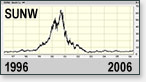
A 10-year test of McNealy’s “profit by banning PowerPoint” idea.
<ERROR! Current quote for stock symbol SUNW or JAVA not available.>
-
Company News: Microsoft Buys Software Unit
Special to the
New York Times, 31 July 1987“The Microsoft Corporation announced its first significant software acquisition today, paying $14 million for Forethought Inc. of Sunnyvale, Calif. … Forethought would remain in Sunnyvale, giving Microsoft a Silicon Valley presence. The unit will be headed by Robert Gaskins, Forethought’s vice president of product development.”
PowerPoint History
The history of PowerPoint's development and its initial rise to success (1984‒1992) has been preserved in a book: Sweating Bullets: Notes about Inventing PowerPoint (San Francisco and London: Vinland Books, 2012, 512pp.).
Robert Gaskins kept contemporaneous private notes for his personal use during that whole period, writing these in a succession of permanently-bound lab notebooks. In these notebooks he documented nearly all meetings, conversations, decisions, and major events, as they occurred. The complete collection of his notebooks (2,400 pages total) is still extant, and was his raw material for the account in this book.
The book also cites and quotes from a large number of previously unpublished documents, mostly written during the early development of PowerPoint and during the acquisition negotiations with Microsoft. Nearly all of these private documents are now on the web, in searchable PDF format, along with the full text of the book, also searchable and with hyperlinks. Full list below.
- Sweating Bullets: Notes about Inventing PowerPoint (San Francisco and London: Vinland Books, 2012, 512pp.). The book is available in Hardcover (ISBN: 978-0-9851424-0-7), Paperback (ISBN: 978-0-9851424-2-1), Ebook for Kindle (ISBN: 978-0-9851424-3-8), and Ebook for EPUB [Google, Apple] (ISBN: 978-0-9851424-4-5), from all booksellers worldwide. It is also available for free download, see next item.
- Download a free searchable PDF copy of Sweating Bullets: Notes about Inventing PowerPoint (San Francisco and London: Vinland Books, 2012, 512pp.) Full text searchable (ISBN: 978-0-9851424-1-4).
-
Original PowerPoint Description
by Robert Gaskins, 14 August 1984—now years ago. (2 pages)The essential point, on day zero: “Allows the content-originator to control the presentation.”
-
PowerPoint Strategy Document (“Product Marketing Analysis”)
by Robert Gaskins, June 1986
(53 pages)This is the complete description of what the PowerPoint product would be, who would buy it, and why; written about one year before initial shipment—now years ago.
-
PowerPoint Strategy Slides
(“New Product Strategy & Review”)
by Robert Gaskins, July 1986
(28 pages)A presentation derived from the preceding document, which also served to illustrate what sort of presentations would be made by the future PowerPoint.
-
Report on the First Year of the Microsoft Graphics Business Unit
by Robert Gaskins, August 1988
(20 pages)Lots of details about the transition to being part of Microsoft. Addressed to all 16 wizards on board at year end, with copies to Bill Gates, Jon Shirley, Mike Maples, Jeff Raikes.
-
GBU Tenth Anniversary of PPT 1.0
by Catherine Belleville, Lucy Peterson, and Aniko Somogyi, 20 April 1997 (8 pages)Includes our cast list of “all the wizards, in order of appearance”, the names of the first 125 people who worked on PowerPoint 1984–1994.
The documents listed below are unpublished documents about PowerPoint history by various authors, referenced in Sweating Bullets: Notes about Inventing PowerPoint , along with archived versions of a few other referenced documents difficult to consult.
-
Andreessen, Marc. 2007. “Part 3: ‘But I Don’t Know Any VCs!’ ” Pmarca Guide to Startups. June 25, 2007. Archived at
www.robertgaskins.com/powerpoint-history/documents/andreessen-pmarca-guide-to-startups-2007-jun-25.pdf -
Austin, Dennis, and Robert Gaskins. 1985. “Presenter [PowerPoint] Design.” 21 August, 1985.
www.robertgaskins.com/powerpoint-history/documents/austin-gaskins-powerpoint-design-1985-aug-21.pdf -
Austin, Dennis, and Robert Gaskins. 1985. “Presenter [PowerPoint] Output Samples.” 21 August, 1985.
www.robertgaskins.com/powerpoint-history/documents/austin-gaskins-powerpoint-output-samples-1985-aug-21-1986-feb-21.pdf -
Austin, Dennis, Tom Rudkin, and Robert Gaskins. 1986. “Presenter [PowerPoint] Specification.” 22 May, 1986.
www.robertgaskins.com/powerpoint-history/documents/austin-rudkin-gaskins-powerpoint-spec-1986-may-22.pdf -
Belleville, Cathy, Lucy Peterson, and Aniko Somogyi. 1997. “PowerPoint: The First Ten Years.” 20 April, 1997.
www.robertgaskins.com/powerpoint-history/documents/belleville-peterson-somogyi-gbu-10-year-reunion-1997-apr.pdf -
Cortén, Dick. 2008. “ ‘Big Boost from Berkeley’: Inventing Critical Breakthroughs Behind the Personal Computer.”
The Graduate, UC Berkeley Graduate Division, Vol. 20 No. 1, 2008.
www.robertgaskins.com/powerpoint-history/documents/berkeley-thegraduate-2008-bigboost-acro7.pdf -
Gaskins, Robert. 1984. “Presenter [PowerPoint] Original Proposal.” 14 August, 1984.
www.robertgaskins.com/powerpoint-history/documents/gaskins-powerpoint-original-proposal-1984-aug-14.pdf -
Gaskins, Robert. 1986. “Presenter [PowerPoint] Marketing Analysis.” 27 June, 1986.
www.robertgaskins.com/powerpoint-history/documents/gaskins-powerpoint-marketing-analysis-1986-jun-27.pdf -
Gaskins, Robert. 1986. “Presenter [PowerPoint] New Product Summary and Review.” 15 July, 1986.
www.robertgaskins.com/powerpoint-history/documents/gaskins-powerpoint-summary-and-review-1986-jul-15.pdf.pdf -
Gaskins, Robert. 1986. “Presenter [PowerPoint] Status Update.” 14 August, 1986.
www.robertgaskins.com/powerpoint-history/documents/gaskins-powerpoint-status-1986-aug-14.pdf -
Gaskins, Robert. 1987. “Forethought Future Business Strategy.” 25 May, 1987.
www.robertgaskins.com/powerpoint-history/documents/gaskins-forethought-strategy-1987-may-25.pdf -
Gaskins, Robert. 1987. “History of Forethought Since the Restart.” 25 May, 1987.
www.robertgaskins.com/powerpoint-history/documents/gaskins-history-of-forethought-1987-may-25.pdf -
Gaskins, Robert. 1987. “Lessons from the Experience of the Restart.” 25 May, 1987.
www.robertgaskins.com/powerpoint-history/documents/gaskins-lessons-of-restart-1987-may-25.pdf -
Gaskins, Robert. 1987. “Response to Microsoft.” 1 June, 1987.
www.robertgaskins.com/powerpoint-history/documents/gaskins-response-to-microsoft-1987-jun-01.pdf -
Gaskins, Robert. 1987. “Response to Microsoft, Extended.” 15 June, 1987.
www.robertgaskins.com/powerpoint-history/documents/gaskins-response-2-to-microsoft-1987-jun-15.pdf -
Gaskins, Robert. 1988. “Results of Microsoft’s Graphics Business Unit after Our First Year.” 8 August, 1988.
www.robertgaskins.com/powerpoint-history/documents/gaskins-gbu-first-year-report-to-microsoft-1988-aug-08.pdf -
Gaskins, Robert. 1992. “Photos of GBU on Sand Hill Road, 1992” (PowerPoint presentation; “.pps” is a self-running slide show,
“.ppt” is a conventional PowerPoint presentation). Includes good photographs of many of the GBU people. 1992.
www.robertgaskins.com/powerpoint-history/documents/gaskins-gbu-photos-sand-hill-road-1992.pps
www.robertgaskins.com/powerpoint-history/documents/gaskins-gbu-photos-sand-hill-road-1992.ppt -
Gaskins, Robert. 2002. Interview by Peter Day. “Power Mad.” BBC Radio 4, London. 10 February, 2002.
www.robertgaskins.com/powerpoint-history/documents/bbc-power-mad.mp3 -
Gaskins, Robert. 2002. Transcript of interview by Peter Day. “Power Mad Transcript.” BBC Radio 4, London. 10 February, 2002.
www.robertgaskins.com/powerpoint-history/documents/bbc-power-mad-transcript.pdf -
Gaskins, Robert. 2007. “PowerPoint at 20: Back to Basics.” Communications of the ACM 50, no. 12 (December 2007): 15–17. On the web at
www.robertgaskins.com/powerpoint-history/documents/gaskins-powerpoint-at-20-cacm-vol50-no12-dec-2007-p15-p17.pdf -
Gaskins, Robert. 2012. “Comments on Dilbert’s History of PowerPoint.” 2012.
www.robertgaskins.com/powerpoint-history/documents/gaskins-comments-on-dilbert-history-of-powerpoint.pdf -
Gaskins, Robert. 2012. “PowerPoint 1.0 for Macintosh 1987, T-Shirt 25-Year Re-Issue.”
The original pre-Microsoft packaging for PowerPoint 1.0 for Macintosh, as shipped by Forethought. 20 April 2012.
Archived design with 25th-anniversary dates at
www.robertgaskins.com/powerpoint-history/tshirt/powerpoint-tshirt-25years-W1722-H2422.pdf -
Gaskins, Robert. 2012. Sweating Bullets: Notes about Inventing PowerPoint.
San Francisco and London: Vinland Books, 512 pp. Library of Congress Control Number 2012936438. LC classification T385 .G379 2012,
LC Dewey class no. 005.5/8. LC Subjects: Gaskins, Robert, Microsoft PowerPoint (Computer file)--History, Forethought, Inc.--History, Microsoft Corporation--History--20th century, Presentation graphics software--History.
Publication formats: ISBN13: 978-0-9851424-0-7 (hardcover) ISBN10: 0-9851424-0-5 (hardcover), ISBN13: 978-0-9851424-1-4 (web PDF) ISBN10: 0-9851424-1-3 (web PDF), ISBN13: 978-0-9851424-2-1 (paperback) ISBN10: 0-9851424-2-1 (paperback), ISBN13: 978-0-9851424-3-8 (ebook kindle) ISBN10: 0-9851424-3–X (ebook kindle), ISBN13: 978-0-9851424-4-5 (ebook epub) ISBN10: 0-9851424-4–8 (ebook epub). 20 April 2012.
Archived searchable full text with hyperlinks to unpublished sources at
www.robertgaskins.com/powerpoint-history/sweating-bullets/gaskins-sweating-bullets-webpdf-isbn-9780985142414.pdf -
Gaskins, Robert, and Dennis Austin. 2002. Interview by Steffan Heuer. “The Revolutionaries of the Office.” Brand Eins (Issue 3, 2002). Translated by Susan Grabau.
www.robertgaskins.com/powerpoint-history/documents/brand-eins-the-revolutionaries-of-the-office-trans-susan-grabau.pdf -
Gaskins, Robert, and Laura Gould. 1972. Snobol4: A Computer Language for the Humanities. Berkeley, CA: University of California, 1972. On the web at
www.robertgaskins.com/files/gaskins-gould-cal-snobol4-1972.pdf -
Gates, Bill. 1991. “Market Share of Applications in the United States.” 19 February, 1991.
www.robertgaskins.com/powerpoint-history/documents/gates-memo-on-office-1991-feb-19-comes-px00577.pdf -
Gold, Rich. 2002. “Reading PowerPoint.” In Working with Words and Images: New Steps in an Old Dance,
edited by Nancy Allen, 256–270. Westport, Connecticut: Ablex Publishing, 2002. (Gold’s chapter was written in 1999). Archived at
www.robertgaskins.com/powerpoint-history/documents/gold-reading-powerpoint-1999.pdf -
Graphics Business Unit, Microsoft. 1989. “GBU Map and Driving Directions.” 10 November 1989.
www.robertgaskins.com/powerpoint-history/documents/gbu-sand-hill-road-driving-directions.pdf -
Lucky, Robert W. 1998. “The World According to PowerPoint.” IEEE Spectrum, January 1998: p. 17.
Original IEEE copy at
ieeexplore.ieee.org/stamp/stamp.jsp?arnumber=00646010
Archived at
www.robertgaskins.com/powerpoint-history/documents/lucky-robert-w-the-world-according-to-powerpoint-ieee-spectrum-1998.pdf -
Maples, Mike. 2004. “An Interview with Mike Maples (OH 387).” Edited by Nathan Ensmenger.
Charles Babbage Institute, Center for the History of Information Processing, University of Minnesota, Minneapolis. 7 May, 2004.
www.robertgaskins.com/powerpoint-history/documents/ensmenger-cbi-interview-mike-maples-oh387mm-2004-may-07.pdf -
Microsoft Corporation. 1987. “Microsoft Letter of Intent for Forethought.” 13 May, 1987.
www.robertgaskins.com/powerpoint-history/documents/microsoft-letter-of-intent-for-forethought-1987-may-13.pdf -
New York Times. 1987. “Microsoft Buys Software Unit.” 31 July, 1987.
www.robertgaskins.com/powerpoint-history/documents/microsoft-buys-software-unit-powerpoint-new-york-times-1987-july-31.pdf -
Rudkin, Tom. 1987. “Appearance of PowerPoint under Windows and Presentation Manager.” 5 October, 1987.
www.robertgaskins.com/powerpoint-history/documents/rudkin-windows-powerpoint-first-spec-1987-oct-05.pdf
David Byrne ♥ PPT
-
David Byrne’s “I ♥ PowerPoint”
an Art, Technology, and Culture Colloquium held at UC Berkeley on 07 March 2005, with invited guests Bob Gaskins and Dennis Austin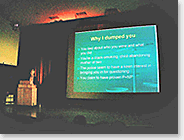
“In one of the most unusual PowerPoint presentations ever given in Dwinelle Hall, ex-Talking Head David Byrne poked fun at the popular Microsoft software’s bullet-point tyranny and Autocontent Wizard inanity. But he also defended its appeal not only as a business tool, but also as a medium for art and theater.”
“ … [Engineering Professor Ken] Goldberg’s preamble was in the form, of course, of a PowerPoint presentation: one with snapshots of businesspeople in offices. They turned out to be 1992 photos of the original team who created PowerPoint, led by Berkeley alumnus Bob Gaskins and Dennis Austin. When Goldberg announced the two men were in the audience — ‘To us engineers, you’re rock stars!’ — the applause was almost as loud as it had been for Byrne.”
From “ David Byrne Really Does ♥ PowerPoint ,” by Bonnie Powell,
with photos by Bart Nagel. -
UC Berkeley News
, review by
Bonnie Azab Powell, 8 Mar 2005 -
Boing Boing
, review by
David Pescovitz, 10 Mar 2005 -
San Francisco Chronicle, review
by Leah Garchick, 11 Mar 2005 -
San
Francisco Chronicle
, review
by Jane Ganahl, 11 Mar 2005 - (More reviews archived)

-
David Byrne’s Journal, Mar 2005:
“Did the PowerPoint talk in Berkeley for an audience of IT legends and academics. I was terrified. The guys that originally turned PowerPoint into a program were there, what were THEY gonna think?” “Bob Gaskins … did tell me afterwards that he liked the PowerPoint as theater idea, which was a relief.”
—David Byrne -
See also:
Envisioning Emotional Epistemological Information
, by David Byrne (hardcover with DVD, Steidl and Pace/MacGill Gallery, 2003),
a large-format art book of Byrne’s PowerPoint images with essays and a DVD of his PowerPoint presentations with original
music soundtracks, based on museum exhibitions.
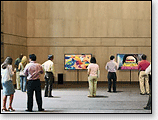
“I have been working with PowerPoint … as an art medium for a number of years. It started off as a joke … but then the work took on a life of its own as I realized I could create pieces that were moving, despite the limitations of the ‘medium.’ ”
—David Byrne
(The book’s website has more, along with installation photos from New York and Tokyo.)
Background
Résumé
March 1993—

Soon after I retired, my wife and I moved to London, where we fully restored an 1890 Victorian “mansion flat” in central London close by Buckingham Palace and № 10 Downing Street (pictures). I became interested in the concertina, the only native English musical instrument and the high-tech musical sensation of the Victorian age, and learned how to play antique examples of the Maccann duet concertina, a nearly forgotten late-Victorian refinement. I studied its history, did extensive research at British research libraries and museums, and published research articles. Life member of the London Library.

I’ve built an authoritative reference library website at www.concertina.com which has gradually expanded to present the work of over a dozen leading scholars plus that of many occasional contributors and collections of historical documents. At the same time, I carried out a project for the Horniman Museum in London to digitize parts of their concertina history archives, now free online at www.horniman.info. The Concertina Research Forum was founded to facilitate interaction among researchers, and I hosted an international meeting of the CRF in London (June 2002). The BBC World Service consulted me as a principal resource for the programme “The Concertina Man” (September 2004) to commemorate the bicentenary of Sir Charles Wheatstone’s birth. I was elected an Honorary Life Member of the International Concertina Association , London, in November 2005.
-
Concertina Library,
www.concertina.com
Documents for the study of English, Anglo, and Duet concertinas: history, instruction books, sheet music, patents, technical papers, rare periodicals, and new research by many leading scholars. Full texts to read, download, and print. See also: articles by Robert Gaskins.
-
Wheatstone Concertina Ledgers,
www.horniman.info
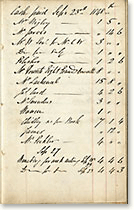
All known production and sales records of C. Wheatstone & Co., 1837–1974, at the Horniman Museum, London, available in full for free to consult on the web. A final press release was issued by the Horniman Museum in July 2005 to announce project completion. See also: How the Wheatstone Concertina Ledgers were Digitized for Publication on the Web and CD by Robert Gaskins, a detailed description of how the 2,300 pages were digitized and a website and CD produced simply and inexpensively using ordinary personal computer equipment.
We lived most of each year in London for ten years (1994–2004), then moved back to live full-time in our 1882 Victorian house in San Francisco that we had purchased in 1987.
Director & General Manager, Graphics Business Unit
July 1987—March 1993

As the creator of PowerPoint I joined Microsoft to be the head of its newly-acquired Graphics Business Unit (GBU), the first business unit outside Redmond, reporting to Bill Gates (later to the innovative manager Mike Maples). I retained full P&L responsibility, with local control of product strategy, budgets, facilities, recruiting, compensation, capital equipment, software development, development tools, quality assurance, marketing, advertising, PR, manuals, internationalization, and worldwide sales liaison. We continued working in the style of a startup and at the same intensity for as long as I was there, through the first three generations of PowerPoint.
the presentation can
make the presentation.”
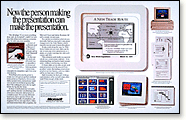
PowerPoint 1.0 (for Mac, April 1987) produced as output black-and-white overhead transparencies (together with speaker’s notes and audience handouts). PowerPoint 2.0 (for Mac, May 1988, and for Windows, May 1990) added output of professional 35mm color slides including online transmission to overnight imaging and processing by Genigraphics. PowerPoint 3.0 (for Windows, May 1992, and for Mac, September 1992) added output of live video color slideshows including slide transitions, builds, animations, and synchronized sound and video clips.
These first three PowerPoint versions completed the basic product functionality which has been refined in further releases since then. They were shipped in over two dozen national languages, and won scores of awards worldwide. Sales grew steadily to a 1992 market share of 63% of presentation graphics software sales on Windows and Mac worldwide against seventeen competitors, with sales of over one million copies of PowerPoint per year (1992).
PowerPoint revenues grew on my watch to well over $100 million annually (in 1992), about half from outside the U.S. We were one of the most profitable units at Microsoft, earning an operating profit margin of 48% of revenues (Microsoft’s operating margin for the same period was 35%, the software industry average was 11%). After I left, others from the original team continued working and ten years later, by 2003, PowerPoint revenues for Microsoft exceded $1 billion annually. By then PowerPoint was being used by over 500 million people worldwide, with over 30 million PowerPoint presentations being made every day. In 2010, Microsoft announced that PowerPoint was installed on over a billion computers worldwide.
Division, Senior
Management, c. 1989
Seated, from left:
Jeff Raikes, Bob Gaskins,
Pete Higgins, Mike Maples,
Susan Boeschen, Tandy Trower
Standing, from left:
Charles Stevens, Peter Morse
PowerPoint was packaged and sold as a stand-alone product prior to the creation of “Microsoft Office,” which began (in 1989 for Mac and in 1990 for Windows) as a transparent overwrap around the separately-manufactured boxes of Word, Excel, and PowerPoint. Only after the success of the physical bundle were the three applications progressively revised to work more alike, provided with a single install program, and packaged together (as well as sold separately). Still later the parts of Office began to be specified and developed as an integrated product, with advantages both to users and to Microsoft. It was this innovation that also required changes to the Microsoft organization, away from the loosely-coupled confederation of independent application business units.
While I headed the Graphics Business Unit we grew from 7 people to nearly 100 people, (about 70 employees and 30 vendor personnel). Microsoft grew from about 1,200 people to 12,000 during the same period. As with any startup, credit for the long-term success of PowerPoint is due to those who were there early to set the direction; the “Wizards of Menlo Park,” the 119 people who worked on PowerPoint from the beginning till the end of the years on Sand Hill Road (1984 to 1994), are listed as “all the wizards in order of appearance” in the GBU Tenth Anniversary of PPT 1.0 document.
The full story of PowerPoint is chronicled in the book Sweating Bullets: Notes about Inventing PowerPoint , by Robert Gaskins (Vinland Books: 2012). This book was written to commemorate the twenty-fifth anniversary of PowerPoint, recounting stories of the perils narrowly evaded as a startup, dissecting the complexities of being the first distant development group in Microsoft, and explaining decisions and insights that enabled PowerPoint to become a lasting success.
PowerPoint has been frequently profiled in the media, most notably by Lee Gomes in his column for The Wall Street Journal to mark the 20-year anniversary of PowerPoint (June 2007). This was followed by an official celebration at Microsoft, and led to a column in Communications of the ACM which included some PowerPoint history. A very good account including live recorded interviews is by Peter Day and Neil Koenig in a radio programme (transcript) for BBC Radio 4 “In Business” and the BBC World Service (February 2002). For the German business magazine Brand Eins, Steffan Heuer interviewed the “revolutionaries of office software”: Charles Simonyi for Word, Dan Bricklin and Bob Frankston for VisiCalc, and Bob Gaskins and Dennis Austin for PowerPoint (Issue 3, 2002). The New York Times reported the details of Microsoft’s purchase of Forethought (July 1987). Many of the early PowerPoint project documents used as source materials for these articles and programmes are now archived online for public access, along with further press coverage.
Vice President, Product Development
July 1984—July 1987

I joined Forethought when it was a year-old startup that had stalled out and was looking to do a re-start around some new business plan, the focus of which soon turned out to be my PowerPoint idea. I had responsibility for our product strategy, all development, product marketing, publications, and manufacturing. Within a month I had written the original PowerPoint description , the first of a succession of product marketing documents refining the PowerPoint product definition. A couple of months later I was able to recruit Dennis Austin (from Gavilan and before that Burroughs) to head the software design and development for PowerPoint. About eighteen months later we attracted Tom Rudkin (from VisiOn and before that Intel) to head the work on a future Windows version of what was being designed and implemented first for Macintosh. We raised about $3 million in new money for the re-start from top-tier venture capital investors led by New Enterprise Associates (Dick Kramlich and Tom McConnell) and Lamoreaux Partners (Phil Lamoreaux), plus Abingworth plc (U.K.) and the very first venture investment ever made by Apple Computer’s strategic investment group (Dan Eilers). An outside board member was Bob Metcalfe, inventor of Ethernet and chairman of 3Com.
While we developed Powerpoint, our company operations were simultaneously built up by contract publishing and selling of software belonging to other developers, so that we were ready and able to sell and ship over $1 million worth of PowerPoint on the day of its initial release—unprecedented for a Macintosh application.
Three months later, PowerPoint history was sharply changed by an offer from Bill Gates to buy PowerPoint and to turn Forethought into Microsoft’s Graphics Business Unit, to be located in Silicon Valley. The offer was orchestrated by Jeff Raikes, who had managed to convince Bill that presentations would become a major application category and that just adding a feature to format Word outlines on overheads (Bill’s first thought, according to Jeff) would not be competitive. We accepted the offer and became Microsoft’s first significant acquisition. The price was $14 million in cash, which returned $12 million to our investors in under three years. I and all the rest of the PowerPoint people, plus many of our other Forethought employees, became Microsoft employees, just a year or so after the Microsoft IPO.
The New York Times reported on 31 July 1987:
company news
Microsoft Buys Software Unit
special to the new york times
San Francisco, July 30—The Microsoft Corporation announced its first significant software acquisition today, paying $14 million for Forethought Inc. of Sunnyvale, Calif.
Forethought makes a program called Powerpoint that allows users of Apple Macintosh computers to make overhead transparencies or flip charts. Some industry officials think such “desktop presentations” have the potential to be as big a market as “desktop publishing,” which involves using computers to lay out newsletters and other publications. Microsoft is already the leading software supplier for the Macintosh.
The personal software industry has been buzzing with acquisitions lately. Microsoft has purchased a 10-employee Berkeley company called Dynamical Systems and has invested in another company, Natural Language Inc. But the acquisition of Forethought is the first significant one for Microsoft, which is based in Redmond, Wash. Forethought would remain in Sunnyvale, giving Microsoft a Silicon Valley presence. The unit will be headed by Robert Gaskins, Forethought’s vice president of product development.
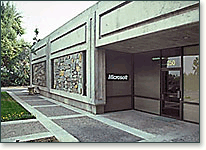
Microsoft’s first presence in Silicon Valley, in 1987: 250 Sobrante Way, Sunnyvale, the circa-1950 tilt-up which had housed our former Forethought startup. This building featured windows so narrow that they had apparently been designed as arrow slits, through which we could shoot our defensive crossbows against attackers.
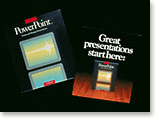
The decision to be acquired, rather than to pursue an IPO already underway, was not easy at the time (though after the stock market crash on “Black Monday” three months later, it appeared brilliantly prescient). One hopeful sign in favor of joining Microsoft was that, where other potential acquirors had sent accountants to do due diligence by reading our bank statements and interviewing our bookkeeper, Microsoft instead sent Dave Moore to actually read through the text of all our program source code and to interview our developers. Fortunately Microsoft turned out to be an excellent fit, and our group remained intact and maintained an amazing degree of organizational independence within Microsoft for as long as that made sense.
Product Marketing Consultant, “Project Vienna”
March 1983—July 1984
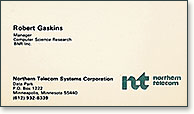
At Bell Northern Research I had spent six months commuting to Minneapolis for meetings of a small strategy group (codename “Anpac”) to decide the global Northern Telecom Ltd. response to personal computers—first to the early Apple ][ and IBM PC, but more importantly to what we saw as the near future, networks of graphical personal computers such as my group had been experimenting with at BNR. After that I volunteered to join the leaders of a European subsidiary team for a crunch project to create and ship a line of networked personal computer and server products, hardware and software, designed for 9 languages. Within 14 months we shipped the first Intel-286–based personal computers in Europe, based on Microsoft system and application software (which was how I came to know Bill Gates).
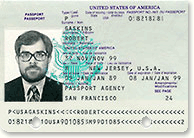
Based on my experiences traveling around the world for this project and receiving hundreds of presentations from people who used overheads and slides and flipcharts (a few made on computers, most not), I began to think about the possibility of a new application to make presentations using the then-undelivered future graphical personal computers such as Macintosh and Windows—the idea which would later be the basis for PowerPoint.
Manager, Computer Science Research
May 1978—July 1984
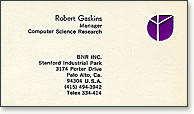
For my first job out of school, I set up a new department at the principal U.S. R&D laboratories of Bell Northern Research, the product development affiliate for Bell Canada and Northern Telecom, Ltd. (much later NorTel Networks), just across the road from Xerox PARC at Stanford. I initiated and managed research and advanced development activities in many fields of computer science and communications, with members of my department focusing on networks of personal computers (using a PDP-10 on ARPAnet, plus Three Rivers’ PERQs and Wirth’s Lilith); graphical user interfaces; digital typesetting; object-oriented systems and programming (Intel iAPX-432 systems, Smalltalk); digital voice-over-IP LANs; SGML (later XML); and extensive research on public-key cryptosystems. I headed the laboratory’s university liaison program, funding external university research programs ranging from computer system architecture to extending Donald Knuth’s TeXTex program for typesetting Arabic scripts.
Education

In 1984 I was one of about 150 people chosen to spend the whole weekend of November 9–11 at the world’s most beautiful repurposed 16-inch gun battery (Fort Cronkhite) on the Marin headlands just north of the Golden Gate, attending the original Hackers’ Conference. This meet-up was initiated by Kevin Kelly and Stewart Brand, and designed by Lee Felsenstein, Bill Budge, Andy Hertzfeld, and Doug Carlston, timed to coincide with the publication of Steven Levy’s book Hackers: Heroes of the Computer Revolution.

Stewart Brand claimed that the invitees were “the most interesting and effective body of intellectuals since the framers of the U.S. Constitution,” a claim that escaped criticism from those attending. Invitees paid a flat $90 for the weekend, including conference, round-the-clock food and drink, and dormitory bunks. Steve Wozniak donated $5,000 for videotaping, and scraps of footage from the weekend later became a DVD. The t-shirt design was by Don Knuth’s student Scott Kim.

In 1979 (after I had joined Bell Northern Research) I attended the International Course in Programming Methodology, an advanced course in programming taught by Edsger W. Dijkstra, followed by a course of forty-nine lectures from Dijkstra, C. A. R. Hoare, Ole-Johan Dahl, John Backus, David Gries, and over twenty additional members of IFIP WG 2.3. This was a four-week residential course, held on the campus of the University of California at Santa Cruz, August, 1979. Classes were held in a steeply-raked auditorium with a raised aisle behind every curved row of desks. Dijkstra assigned in-class programming problems, and would then walk along the aisles, looking down over everyone’s shoulders to inspect their work. It was unnerving when he stopped and lingered behind your chair.

Dijkstra recorded his own thoughts about the course in his contemporaneous typescript “trip report” (EWD 714) now archived online at the University of Texas: “I found the UCSC [UC Santa Cruz] campus not an inspiring place, and the longer I stayed there, the more depressing it became. … We had to share the food—and what was worse: also the space in which to consume it—with the participants in other ‘educational’ activities—such as a cheer-leaders school and a school of American football … In short: the place breathed an atmosphere of uncivilization.” “The audience was of a higher calibre than we had been led to expect … eight people from various Bell Laboratories … 30 to 40 per cent. could only be described as mathematical illiterates … .” “… my overwhelming memory from this WG2.3 meeting is the very lousy impression I got from Xerox PARC … [a place where] research in computing science is primarily viewed as gadget development, rather than as gaining insight.”
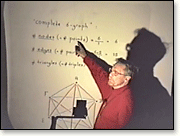
Twenty-two years after this, Dijkstra was still using a pen to write his own overhead “foils” (transparencies) in his distinctive handwriting, and was thoroughly disapproving of how others had come to use PowerPoint. From another trip report (EWD 1310): [Preparing to receive an honorary doctorate in Athens, May 2001] “Fortunately I had discovered in time that I had left my prepared foils in Nuenen and the University had provided me with blank ones and pens. I used Wednesday’s free moments to make new ones.” [And a month later, June 2001, after appearing at a “Software Pioneers” conference in Bonn that featured 16 speakers] “I mention another way of looking at the whole happening, viz. regarding it as a 16-fold confirmation of the ruinous influence of PowerPoint, for the less of it you use, the better your lecture. … The bloody electronics only encourage the next steps of the replacement of content by form … .”
Computer Scientist
July 1973—May 1978
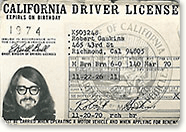
While a graduate student, I co-authored (with Laura Gould) a textbook on programming for linguistic and humanities research, used in courses at Berkeley and Stanford, and in summer sessions for college teachers in the humanities organized by the American Council of Learned Societies. I did extensive consulting with Berkeley faculty members on the use of computers to study literature, languages, arts, and music. I was graphics consultant for the Berkeley Campus Computer Center. I spent some years as chief programmer for Berkeley machine translation research (Chinese to English). I did the programming of ancient Egyptian hieroglyphic fonts and typesetting for the Berkeley Late Egyptian Dictionary. I wrote a program to generate haiku, which was embedded in the idle loop of a campus CDC6400 and became the most prolific poet up till that date, with a selection published in an anthology of computer poetry edited by Richard W. Bailey (Computer Poems, 1973). One of my motivations for choosing Berkeley was Professor Bertrand Bronson in the English Department, who had pioneered the study of the traditional tunes of English and Scottish popular ballads by coding the music and transcribing it to punched cards for analysis on tabulating machines; I was able to help him with computer analyses and concordances. There were many more projects in graphics and music and natural language.
by Robert Gaskins and Laura L. Gould
Berkeley: University of California, 1972 (vii+188 pages)
(a Snobol4 for CDC 6400 by Charles Simonyi and Paul McJones)
(Free download, full text in searchable PDF)
(Open Library web page for this book)


(Project on Linguistic Analysis, Report no. MT-Q1)
by Robert Gaskins et al.
Berkeley: University of California, 1973
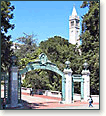
M.A. 1973, in Computer Science, Linguistics, and English
I was admitted to the Ph.D. program in the English Department at the University of California, Berkeley in 1968. My wife was admitted to the Linguistics Department for a Ph.D. at the same time, and 1968 was an excellent year to arrive in Berkeley. I entered with a Special Career Fellowship from the Ford Foundation for five years of complete support. My intention was to specialize in Shakespeare and follow an academic career teaching literature and linguistics, but before I registered for my first classes, I read in the catalogue and discovered classes in the Computer Science Department (in the College of Letters and Science, spun off from the Math Department).
My advisor, Josephine Miles, the poet, agreed that some exposure to computers would be broadening, so I enrolled in a beginning programming class. I was immediately enthralled, took more classes (CDC 6400 assembly language from Butler Lampson was memorable), and soon I formally broadened my program; this was possible because the Special Career Fellowship made me independent of any department.
I was approved to undertake an “individual interdisciplinary Ph.D. program” in the College of Letters and Science, combining all of the individual degree requirements of all of the Computer Science, Linguistics, and English Departments. This was a wise step for the purpose of getting an education, but not necessarily wise for the purpose of ever completing the degree.
Pursuing a Ph.D. in three fields at the same time provided ample excuses for any shortcomings. The computer scientists thought I was reasonably smart, at least for a student whose interests were in such nebulous areas as analyzing literary language and music. The literary people thought I was a tolerable critic, at least for a student whose interests were more in linguistic structure of language and in computer analyses. The linguists thought I had some useful observations, at least for a student whose interests were more in formal languages and literary language than in collecting field data about obscure tribal tongues.
Over the next ten years, I passed:
—university Ph.D. language examinations in Latin and in French;
—Computer Science Department Ph.D. comprehensive written exam;
—Linguistics Department Ph.D. comprehensive written exam;
—English Department Ph.D. comprehensive written exam;
—Ph.D. oral examination, with examiners from all three departments;
—oral defense of topic for Ph.D. dissertation, with examiners from all three departments (at this period, the dissertation defense was conducted after preliminary work and before writing), with the topic “Use of Two-Level van Wijngaarden Grammars for Natural Language Analysis”
(Advisor: Charles J. Fillmore).
This completed the requirements for the “Cand. Phil.,” which at the time was the Berkeley official status corresponding to the unofficial “ABD” (“all but dissertation”) degree status for Ph.D. students, with an M.A. degree awarded along the way.
But by 1978, after ten years at Berkeley, I had decided I needed to write that dissertation far less than I needed to move to Silicon Valley, where I could get the experience to do a software startup for the new single-user personal computers. These were very early days; at the time I felt I had to leave Berkeley, Bill Gates had left Harvard less than three years earlier, and he was then still in Albuquerque, writing software for the MITS Altair (Bill only relocated Microsoft to the Seattle area after I had moved to Silicon Valley). The first Apple ][ had been introduced only a few months before. And just as 1968 had been a great year to move to Berkeley, 1978 was a great year to move to Silicon Valley.
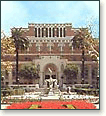
A.B. 1968, in English Literature
I transferred to the University of Southern California as a junior, and joined the honors program in the English Department. There, one of my major advisors was Professor Virginia Tufte, who was particularly encouraging in helping me to gain admission offers from several leading graduate schools. (Her son Edward Tufte, who was about my same age, would later attract a great deal of attention for his important work on presentation of information, and incidentally also for his opinions about PowerPoint.) I was elected to Phi Beta Kappa, and received the Order of the Palm award at graduation.
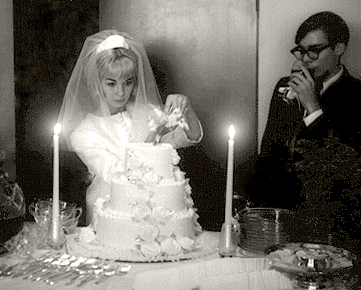
1966, to Leanna Jean Koehn
Married 31 July 1966
at the First Congregational Church in Los Angeles,
by Dr. James W. Fifield, Jr.


1964‒1966, English Literature
I re-entered conventional higher education at Los Angeles City College, a large and well-established two-year community college located on what had once been the original campus of UCLA in central Los Angeles, where I studied English literature and was selected to be the editor of the campus literary magazine.
1960‒1964, economic theory and history
I was expelled from high school for showing disrespect of administrators, a charge that was undeniably true. (My beef was that they allowed a poor math teacher to choose a textbook not sophisticated enough for the Honors Mathematics track.) I was happy to be expelled indefinitely, and just dropped out permanently. I never completed high school or any equivalent, never took any equivalency test, and nobody ever cared. My scores on national exams gave me admission to universities anyway, and I tried out two of them for one semester each, but I was interested in studying other things. (1960–1961)

I interrupted university for a self-directed three-year program to study libertarian economic theory and history. I began with a year’s term as one of the first two residential interns at the Foundation for Economic Education, at that time headed by Leonard Read and located on an estate in Irvington-on-Hudson, New York, just north of New York City. In that first year, I mostly read in their large library the classic books, which were in those days out of print and hard to find, talked with frequent important visitors to the Foundation, and made occasional field trips to visit individualist luminaries such as Rose Wilder Lane. (1961–1962)
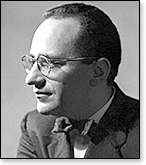
The second year, I lived in Manhattan and regularly went to listen to the weekly open seminars of Ludwig von Mises at New York University. More significant to me, during the same period I participated in Murray Rothbard’s salon held in his Manhattan apartment, an echo of his “Circle Bastiat” group of a decade earlier. When Rothbard’s contemporaneous notes from that period were published in 2007, I found to my surprise that he had mentioned me then as being one of “the nation’s leading young libertarians,” a comment on how few of us there were in those days. So the second year focused on Rothbard and Mises, and on reading classic books that came up in their discussions. (1962–1963)
In the third year, I attended the Phrontistery, a one-year program in libertarian economics for eighteen students, held at Rampart College in Colorado, where the visiting faculty included a number of scholars from many universities: Milton Friedman, Gordon Tullock, James J. Martin, Ludwig von Mises, Murray Rothbard, F. A. Harper, Bruno Leoni, G. Warren Nutter, Arthur A. Ekirch, Sylvester Petro, Oscar W. Cooley, and Roger J. Williams.
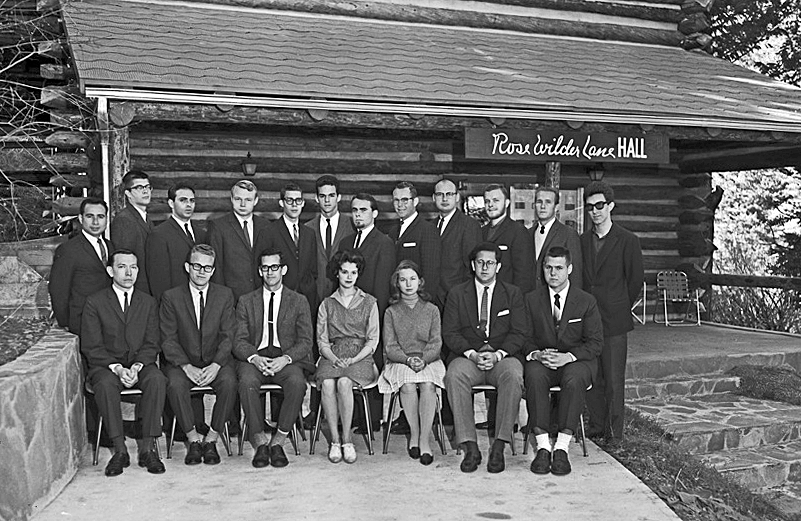
Murray Rothbard later wrote about this period too, and mentions in his notes that at the Phrontistery “for the first time in public some of the group also unfurled the ‘black-and-gold-flag’ [one side pure black, the other side pure gold], the colors of which we [the salon in New York] had all decided best represented anarcho-capitalism.” The flag belonged to the fellow-Phrontisterian who had sewn it; she and I married two years later, and now, more than 50 years after it was made, the original historic banner stands in a corner of the library at our home in San Francisco. (1963–1964)
I might well have continued my studies, but increasingly I realized that “I came into this world, not chiefly to make this a good place to live in, but to live in it, be it good or bad” (Thoreau, in his Resistance to Civil Government). So I adopted one of Robert LeFevre’s gnomic sayings, that the person “… who knows what freedom means, will find a way to be free.” The road was cleared, and I was going back to the world.
Footnotes to History
The very first public use of a laptop to project video from PowerPoint took place on 25 February 1992, at the Hotel Regina, in the Place des Pyramides, Paris (across from the Tuileries). With a laptop casually under my arm, I entered at the back of a ballroom filled with hundreds of Microsoft people from the European, Middle Eastern, and African subsidiaries. I walked through the audience carrying the laptop, up to a podium at the front; there I opened the laptop, and plugged in a video cable on the lectern. I began delivering a presentation to introduce PowerPoint 3.0 for Windows, using PowerPoint 3.0 running on the laptop feeding video out to a projector the size of a refrigerator which put the "video slides" onto a huge screen behind me. No one had ever seen PowerPoint running on a portable computer before, let alone being used to produce a real-time video show in color with animated builds and transitions. The audience, all Microsoft people who talked to customers frequently, grasped immediately what the future would bring for their own presentations; there was deafening applause.
The computer hardware was only barely there. I was using an early-production color notebook computer (from Texas Instruments) with 640x480 256-color screen and video out, and sufficient CPU to do graphics. We managed to get hold of two such machines in the U.S., which we loaded with Windows 3.1 Release Candidate 1 and PowerPoint 3.0 Alpha 1, plus a presentation about PPT 3.0. (The unreleased Windows 3.1 was required in order to use TrueType fonts and to include audio and video, as well as for many other graphics improvements which PowerPoint 3.0 would rely upon.) The two machines were hand-carried on separate airplanes to Paris, since no similar machines were available anywhere in Europe. The entire day Monday 24 February 1992 was spent in the ballroom of the Hotel Regina with a staff of local audio-visual consultants installing and trouble-shooting the massive video projector (the only kind that then existed). Testing and tweaking went on far into the night, but on Tuesday morning, I could “casually” carry my laptop up to the front, plug in the video cable, and start my PowerPoint. The demo went off without a hitch.
Similar demonstrations were given in the U.S. and in other parts of the world over the next three months. Windows 3.1 was shipped in April 1992 and PowerPoint 3.0 immediately followed in May 1992; in response many notebooks with color and video were shipped later that same year.
Video slideshows projected from a laptop computer were initially possible only for presenters in specialized venues using professional equipment, but as new video projectors that were small, bright, and inexpensive gradually became available over the next several years this became the most popular PowerPoint presentation format for everyone, and eventually it displaced traditional overheads and 35mm slides. Within a few years what had been a unique demo would become a commonplace worldwide in auditoriums and large corporate conference rooms and then would become ubiquitous in small meeting rooms in businesses of all kinds during the tech boom of the late 1990s. All this was predicted in my strategy documents from the mid-1980s; what was unexpected was that the same hardware would also extend PowerPoint use into university teaching, children’s school reports and science fair projects, sermons in churches, super-titles for opera houses, and many other uses that its creators had never imagined.
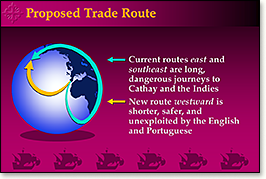
The slides I used to demonstrate PowerPoint 3.0 included the device of a notional proposal being made to Queen Isabella by Christopher Columbus seeking financing to sail to America; this presentation had been designed for us by our partner Genigraphics in several formats, including video.
The Columbus theme was used in all our marketing materials, packaging, and demos worldwide beginning with Forethought PowerPoint 1.0 in 1987 through PowerPoint 3.0 in 1992–1993, and in consequence the GBU celebrated Columbus Day, the second Monday in October, as a business-unit holiday. The last use of the theme for the 1992–1993 launch of PowerPoint 3.0 coincided with the 500th anniversary of Columbus’s voyages to America, so the ship awards incorporated U.S. Columbian half-dollar coins minted for the Columbian Exposition exactly a century earlier in 1892 (Windows ship) and 1893 (Mac ship).
The inspiration to create a presentation for Columbus’s project came from the best book I know about how to make presentations, Moving Mountains: The Art of Letting Others See Things Your Way, by Henry M. Boettinger (New York and London: Macmillan, 1969, frequently reprinted but now out of print). Because Boettinger wrote twenty years before PowerPoint was invented, he focuses on the communication techniques without being distracted by the irrelevant mechanics of any software application.
Videos
A survey of the state of Desktop Presentation software in 1989. This part I, for Macintosh,
includes a demo of PowerPoint 2.0 (at 09:15), presented by the GBU’s Connie Clark (Wizard #26) who demonstrates
how PowerPoint differed from its competitors, represented here by MORE II, Aldus Persuasion 2.0, and Macromind Director.
An episode of the "Computer Chronicles" television series, hosted by Stewart Cheifet and Gary Kildall.
View video at Internet Archive
A survey of the state of Desktop Presentation software in 1989; this is part II, for IBM PC.
PowerPoint had not yet been released for Windows, so this survey documents its competitors who would be dramatically disrupted the following year. The old guard is represented here by
Harvard Graphics 2.12, Draw Partner, Freelance Plus 3.01, Graph Plus 1.3, Storyboard Plus 2.0, GEM Presentation 1.1, AutoDesk Animator, and Xerox Presents. (Some of these are on
Windows 2.0, illustrating why we considered it unacceptable for PowerPoint.) An episode of the "Computer Chronicles" television series, hosted by Stewart Cheifet and Gary Kildall.
View video at Internet Archive
A survey of Windows 3.0 and its competitors in October 1990. The Windows 3.0 demo includes (at 19:30) a demo
of PowerPoint 2.0, presented by the GBU’s Cathy Harris (Wizard #28) who demonstrates
how PowerPoint for Windows is virtually identical to PowerPoint on Macintosh. (This is a good example of how the major 3.0 upgrade to
Windows was introduced by using PowerPoint 2.0 demos to show off that Windows had finally caught up to Mac.) Other systems
include DR-DOS 5.0 and GEM from Digital Research, GEOS and Ensemble from GeoWorks, and ViewMax.
An episode of the "Computer Chronicles" television series, hosted by Stewart Cheifet and Gary Kildall.
View video at Internet Archive
Comedy videos to punctuate Microsoft company meetings were made by individual business units
using strictly internal resources and talent (and amusing only to insiders).
This one was shot in 1992 with cast and crew of GBU Wizards at our “Sand Hill Road Studios” in sunny California
for a large Apps Division meeting to be held in rainy Redmond.
Written, produced, and directed by Robert Safir, GBU Wizard #14; narrated by Bruce Lee, GBU Wizard #44.
View video at Youtube
“An ode to our favorite office presentation program …
made using said program.”
Words by Suite Dreams
(Sara Schaefer and Erik Marcisak)
Vocals by Cock Lorge
Edited by Sara Schaefer
View video at Youtube
“Don McMillan gives a short comedy sketch around PowerPoint presentations and the common mistakes that people make.”
Don believes that he is
“the only comedian working in PowerPoint”;
that’s clearly not true (every day you see quite a few in random meetings), but he’s certainly a lot funnier than
the other ones.
View video at Youtube
Delivered as the keynote speech at the Ig Nobel Prize Ceremony, 4 October 2007, Sanders Theater, Harvard,
and previously published in the
Annals of Improbable Research, vol. 12 no. 5 (September-October 2006).
A PDF of the article is available.
Presented at the American Academy of Arts and Sciences [AAAS] humor session, 16 February, 2007.
View video at Youtube
Presented at Carnegie Mellon 11th Annual SIGBOVIK (2017), 31 March 2017.
“More generally, for a given alphabet size a, a PPTXTM [PowerPoint Turing Machine] with n states and m tape cells uses O (n2 + m2) animations and O (nm) AutoShapes.”
—Tom Wildenhain
Paper: Preprint (PDF, typeset in PowerPoint), download from CMU.
PowerPoint File: PPTX, download from the author’s website.
View video at Youtube
Flatland, by Edwin A. Abbott [A. Square, pseud.], 1884.
(Original publication digitized.)
“Because (almost) all of the characters in Flatland are two-dimensional geometric shapes,
PowerPoint actually seemed like a natural tool to use to tell the tale in a more visual
way to a modern audience.” (Not a video, but a PPT presentation—39 MB.)
Remix/Design/Score by Zeus Jones
Open PowerPoint presentation

Humor
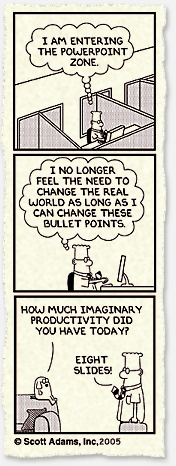
- Comments on Dilbert’s History of PowerPoint , an analysis of the history of PowerPoint reflected in about 100 Dilbert strips by Scott Adams (through 2011).
- A few cartoons about PowerPoint , collected since PowerPoint emerged as a popular topic beginning in the mid-1990s.
-
The PowerPoint Anthology of Literature
,
by Daniel Radosh, June 2003 -
PowerPoint Remix of Tufte
by Aaron Swartz, 23 May 2003

-
PowerPoint Ranger Creed,
“Furnished anonymously by a Pentagon power briefer,” April 2000.Described in the Jaffe article in the Wall Street Journal (listed in press, above).
-
The Gettysburg PowerPoint Presentation,
by Peter Norvig,
“19 November 1863”
“And now please welcome President Abraham Lincoln.”
See also: The Making of the Gettysburg PowerPoint Presentation , by Peter Norvig, updated.
Around the Web
Robert Gaskins main entry at Wikipedia
Robert Gaskins identifier at Wikidata
Robert Gaskins author authority at Library of Congress
Robert Gaskins author authority at VIAF
Robert Gaskins name authority at ISNI
Robert Gaskins profile at ORCID
Robert Gaskins profile at Researcher ID
Robert Gaskins profile at ResearchGate
Robert Gaskins citation index at Berkeley Electronic Press
Robert Gaskins citation index at Academia.edu
Robert Gaskins citation index at ACM Digital Library
Robert Gaskins citation index at Google Scholar
Robert Gaskins profile page at Elmcip
Robert Gaskins profile page at Github
Robert Gaskins author page at Amazon
Feedback
Link out rotted away? Let me know.